Starlink vs Amazon Leo: what to choose on the French Riviera in 2026
Two constellations, one promise
For five years, low Earth orbit (LEO) internet in France came down to a single name: Starlink. That is no longer the case. Amazon Leo — Amazon's constellation, known as Project Kuiper until November 2025 — is arriving on the French market.
We are a satellite installer working across Alpes-Maritimes and Var, with no exclusivity with either operator. Here is what is actually known today, and what it means for an installation project on the Riviera.
Where things stand in August 2026
Starlink
- Commercially available in France, sign up immediately.
- Speeds measured on our installations in the 06 and 83: 150 to 300 Mbps download, 40 to 60 ms latency.
- Installation possible within 5 to 10 days of quote approval.
Amazon Leo
- Not yet open to residential customers in France.
- Arcep authorisation upheld by the Conseil d'État in July 2026: the legal framework is in place.
- Business early access already launched.
- Residential launch expected late 2026 / early 2027.
- No field speed measurements exist in France to date.
The most important point fits on one line: today, if you need internet, the only satellite option you can actually subscribe to in France is Starlink. Everything else is preparation.
The Amazon Leo dishes
© Amazon
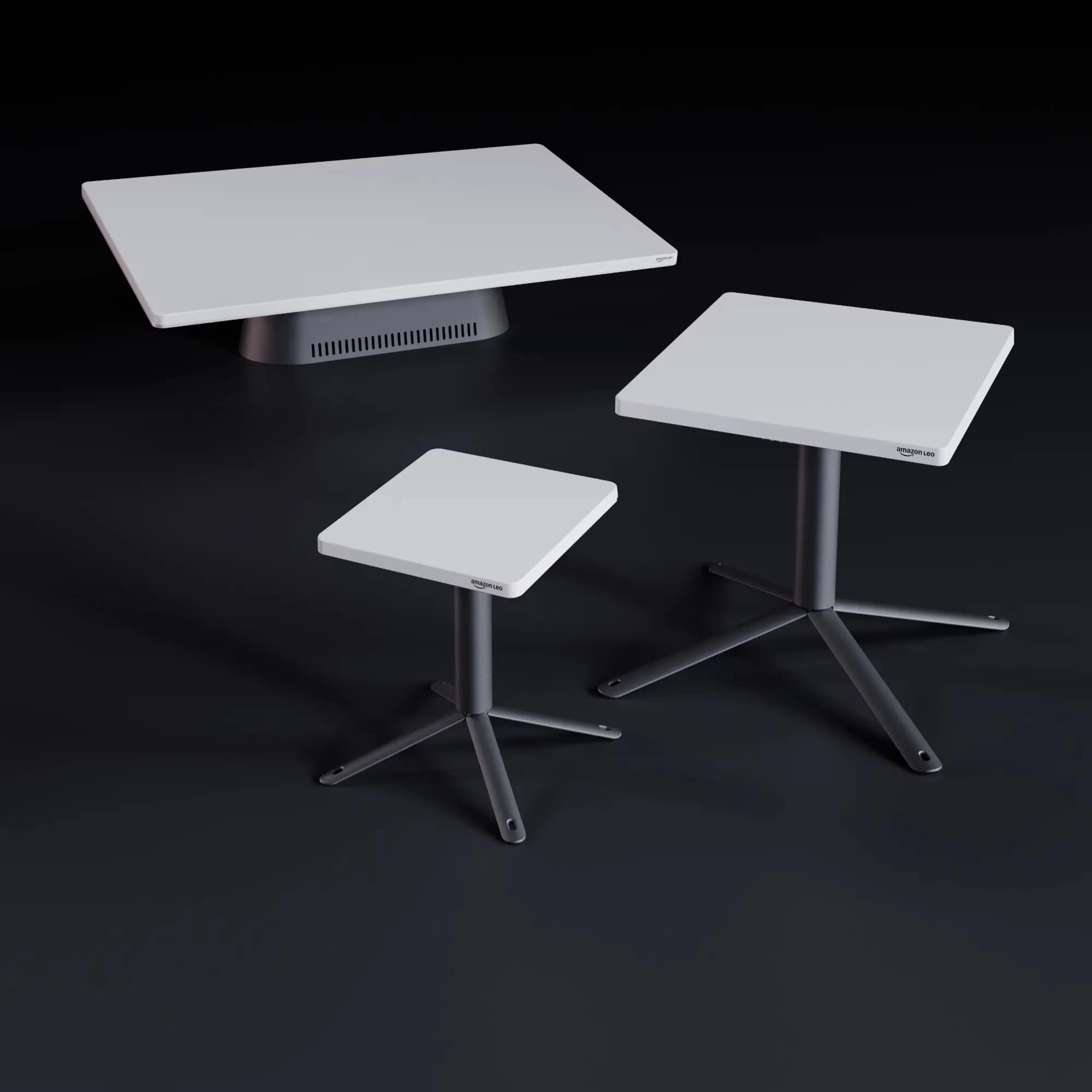
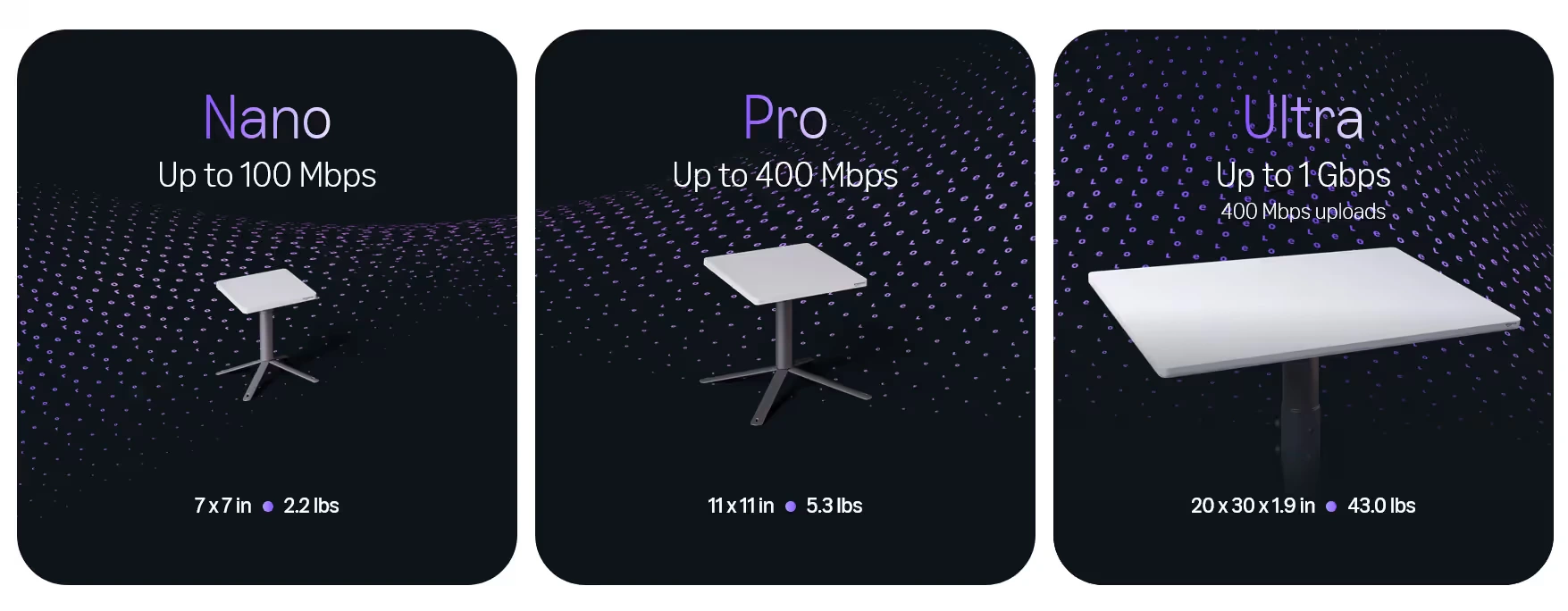
Amazon has announced three terminals, where Starlink largely relies on a single residential range:
- Leo Nano — up to 100 Mbps. 18 × 18 cm (7 × 7 in) at 1 kg. Compact, aimed at occasional use, a second home or a small household.
- Leo Pro — up to 400 Mbps. 28 × 28 cm (11 × 11 in) at 2.4 kg. The closest thing to a fibre connection for a whole family: several 4K streams, video calls, cloud and home automation at once.
- Leo Ultra — up to 1 Gbps, including 400 Mbps upload. 51 × 76 cm (20 × 30 in) at 19.5 kg. A business-oriented terminal for sites that must carry dozens of simultaneous users.
Read those figures carefully: they are announced maximums, not guaranteed throughput. With Starlink, the gap between the theoretical peak and what is actually measured at a client's property is consistent — there is no reason Amazon will be different. We will publish our own readings as soon as we complete our first installations in the 06.
What dish size actually changes
This is the point comparison articles consistently miss, and it is the one that costs money when handled badly: a larger dish catches more wind.
Look at the gap: between the Nano and the Ultra there is a twenty-fold difference in weight (1 kg against 19.5 kg) and twelve times the surface area. Putting 19.5 kg on a 51 × 76 cm panel on a roof is no longer a dish installation — it is a job that requires a structural load assessment.
Along the Riviera coast — from the gusts funnelling down the Var valley at Saint-Laurent-du-Var to the direct marine exposure at Roquebrune-Cap-Martin — a Leo Pro or Leo Ultra terminal cannot be fixed like a compact dish. An oversized mount, sometimes guyed anchoring, and A4 marine-grade stainless steel within a few hundred metres of the shore: the model you choose has direct consequences for the installation quote.
How we advise our clients
Our answer depends on a single question: is your need immediate?
If yes — we install Starlink. The service works, we install it every week across the 06 and 83, with an average lead time of 5 to 10 days after quote approval. Waiting for an unreleased service when a household has no working connection makes no sense.
If you can wait a few months — a house under construction, a second home, or a contract coming up for renewal — we pre-qualify your site for both constellations. The eligibility study and technical visit are free, and the work involved (obstruction test, mounting point, cable route, co-ownership approval where needed) is valid whichever constellation you end up choosing. That is what allows us to install within days of launch, rather than waiting weeks in the queue.
If you are a business, there is a third route: multi-link. Two separate connections with automatic failover on a Ubiquiti or TP-Link Omada router. We already deploy this with Starlink as a fibre backup — and in future, Starlink and Amazon Leo will be able to play that role for each other.
What will actually separate the two offers
Until Amazon Leo opens, nobody can call it honestly. Here is what we will be looking at, in order, from our first installations:
- Real measured speed at peak hours, not the announced peak. Evening congestion is what makes the difference on a satellite connection.
- Latency on video calls, the decisive criterion for remote workers in Valbonne and Sophia Antipolis.
- Total first-year cost: hardware plus subscription plus installation. Amazon has not yet published French residential pricing.
- Constellation density over France, which drives real-world stability.
- Support quality when something fails — a criterion our clients invariably mention after the fact.
In short
Amazon Leo is good news: a credible second LEO constellation means competition on price and on service quality. But it is not yet an option available to a private customer in France.
Our position as an independent installer is simple: we have no interest in selling you one brand over another. What we sell is a mount that survives ten years of sea wind, and Wi-Fi coverage that reaches the far end of the garden — and that is identical whichever dish sits at the end of the cable.
Further reading:
- Amazon Leo installer, 06 & 83 — status in France, dishes, the 4-step process and full FAQ
- Starlink installation on the French Riviera — the option available today
- Why hire a professional installer?
- Mesh Wi-Fi: covering a whole villa without dead zones — because the dish only does half the job